

VTA REGULATORY ALERT: HHS Unified Agenda Published

Published on July 28, 2026
TO: VTA Members
DATE: July 28, 2026
RE: Regulatory Alert: HHS Unified Agenda Published
Each year the Administration publishes its Unified Agenda as the public reporting mechanism for regulatory and deregulatory actions under development across the federal government. (RegInfo.gov). The 2026 HHS Unified Agenda was quietly published yesterday. Regarding regulations pertaining to our industry and PMTAs, specifically, the HHS/FDA agenda signals a FDA tobacco regulatory pivot toward enforceable standards, import controls, and supply-chain enforcement, especially for ENDS. We address nine relevant rules included in the agenda.
What is striking is that FDA appears to be adopting the approach for PMTAs for which we have been clearly advocating
Tobacco Rules on Unified Agenda
Proposed Rules with PMTA Implications. The first three proposed rules below impact PMTA requirements and review and could provide a basis for clarifying and streamlining the requirements.
- FDA Answers VTA’s Call for ENDS Tobacco Product Standards.
For years (for-ever), FDA has refused to consider implementing tobacco product standards for ENDS products even though it is one of the key requirements in the PMTA statute. Now, for the first time, HHS/FDA announced that they will be proposing a new “Product Standards for Electronic Nicotine Delivery Systems” rule, scheduled for July 2026, which FDA describes as creating ENDS product standards under FDCA §907 to “establish product standards for ENDS products to provide greater clarity and predictability for industry and stakeholders by describing standards applicants must meet as part of premarket review.” As you know, this is one of the two things that VTA has said was essential and it is being proposed for the same reason we have articulated: “clarity and predictability.” (Tobacco Product Standards)
The notice provides no specifics but it is a very encouraging sign for the reasons stated above and it is a major departure from all prior FDA positioning.
2. FDA Answers VTA’s Call for Standards on ENDS toxicants/impurities.
The ENDS Safety Standards rule, RIN 0910-AI06, would establish standards for ENDS, including purity standards for nicotine, propylene glycol, and vegetable glycerin in e-liquid. FDA states that toxicants and impurities in those ingredients can cause death or other adverse health effects and that the rule would set limits appropriate for public health protection. (ENDS Safety Standards Rule) A similar rule was first proposed during Trump’s first Administration but once the youth vaping epidemic took center stage, the focus shifted, as you all know, to talk of a flavor ban.
Once again, a key element of our messaging for our science-based guidance has been to address these issues to ensure the “safety” of ENDS products. This message was recently reiterated during our meeting with Secretary Kennedy. Again, the notice provides no specifics so we will have to review the proposed rule when it comes out. But, this is potentially another positive development if the standards are objective, track what we have proposed, and commercially feasible. They could create a clear compliance baseline for ingredient suppliers and e-liquid manufacturers. They also could support a more rational PMTA review process.
3. Environmental Assessment requirements may be limited/withdrawn.
The Environmental Impact Considerations rule would update FDA’s NEPA regulations. FDA says the updates include removing reliance on CEQ regulations, removing FDA’s rule on environmental effects abroad of major agency actions, incorporating statutory deadlines/page limits, and creating new or updated categorical exclusions. FDA identifies the rule as deregulatory. (Environmental Assessment Rule)
For tobacco, this could matter because PMTAs require environmental assessments or categoricalexclusion analyses. While the proposed rule is not tobacco-specific, it could reduce PMTA submission burdens if FDA broadens categorical exclusions or streamlines environmental documentation.
Proposed Rules with Enforcement Implications. The following four rules would enhance FDA’s enforcement capabilities. The four rules should be read together as defining a clear policy architecture emphasizing enforcement: identify the source, identify the product, screen the import, identify PMTA status, detain the noncompliant product.
4. The ACE import rule being finalized.
The previously published ACE import-data final rule is expected to be published as a final rule in September 2026. It would amend 21 CFR 1.79 to require import filers to submit the FDA premarket application number at entry for ENDS products. FDA says this will allow it to determine the marketingauthorization status of ENDS imports more effectively and enforce Chapter IX premarket requirements. (ACE import-data rule)
5. Administrative Detention Rule moving forward.
The Administrative Detention of Tobacco Products would allow detention of products believed to be adulterated or misbranded when encountered during inspections of manufacturers, vape shops, or other establishments that manufacture, process, pack, or hold tobacco products. FDA specifically identifies unauthorized e-cigarettes and illegal overseas shipments as targets. (Administrative Detention of Tobacco Products) The legal and practical effect is that FDA would gain a much faster tool to stop movement of products before a full seizure action. FDA explains that detention would give the agency time to consider further action, including DOJ involvement and seizure, and says the authority would help prevent firms from moving products to evade seizure. (Administrative Detention Rule) For retailers, distributors, and importers, this materially increases operational risk: products may be frozen in place before the company has a full adjudication on the merits.
6. Establishment Registration and Product Listing.
We previously reported to you the Establishment Registration and Product Listing rule that was recently published. Again, FDA says current law requires only domestic manufacturers to register and list, creating “significant gaps” in FDA’s information, and that the rule would extend registration/listing and FDA inspections to foreign establishments and new domestic categories. (Establishment Registration and Product Listing)
7. Civil Monetary Penalties.
FDA announced that it will implement an Interim Final Rule called CY 2026 Civil Monetary Penalties Inflation Adjustment, RIN 0991-AC42 to adjust for inflation the administrative penalties it can impose for violations. The rule is expected to be finalized in January 2027. While this will increase penalties, a recent court case has found that FDA can no longer impose these penalties through its own administrative law process. As such, for FDA to pursue these penalties (often imposed on small businesses), it will have to do so through the courts which could dramatically impact its willingness to pursue them. Other Related Rules. There are two additional rules of note that could impact the tobacco segment.
8. Tobacco Product Manufacturing Practice rule still active, but not immediate.
The previously announced Tobacco Product Manufacturing Practice rule remains in long-term actions, with a final rule projected for July 2027. FDA says it would establish manufacturing-practice requirements for finished and bulk tobacco products, including manufacture, pre-production design validation, packing, and storage, to prevent contaminated or nonconforming products. (TPMP Rule)
9. HHS Petition Process Rule may create a useful deregulatory pathway.
The Petition Process for Rulemaking and Regulatory Review rule is listed as a first-time HHS Office of the Secretary rule at the final-rule stage, with an interim final rule expected in July 2026. It would establish procedures for petitions to amend or repeal rules under 5 U.S.C. § 553(e) and for regulatory review under 5 U.S.C. § 610(b). HHS characterizes it as deregulatory and says the rule is intended to reduce burdens, standardize petitions, and improve transparency. (HHS Petition Process Rule)
For the tobacco sector, this could become a formal pathway to seek amendment or repeal of outdated or unworkable rules. It may also be relevant to small-business advocacy because § 610 review focuses on rules that have significant economic impact on a substantial number of small entities.
What this means strategically
This Unified Agenda is best understood as a standards-and-enforcement package. FDA appears to be moving toward a system in which ENDS products are governed by clearer standards, but those standards are paired with better enforcement tools. Both of these are concepts that VTA has vigorously advocated for pursuant to the strategic plan that you have endorsed.
For responsible manufacturers, especially companies already in the compliance process, the opportunity is that FDA may finally articulate objective standards that can be met.
For retailers and distributors, the most immediate risk is enforcement disruption. Administrative detention and ACE import screening could affect inventory movement well before broader product-standard litigation or PMTA disputes are resolved. This is why we are pushing for a comprehensive solution to the current PMTA review/enforcement scheme.
For foreign manufacturers, the direction is unmistakable: FDA wants visibility, traceability, and inspection/enforcement leverage over foreign-made tobacco products entering the U.S. market.
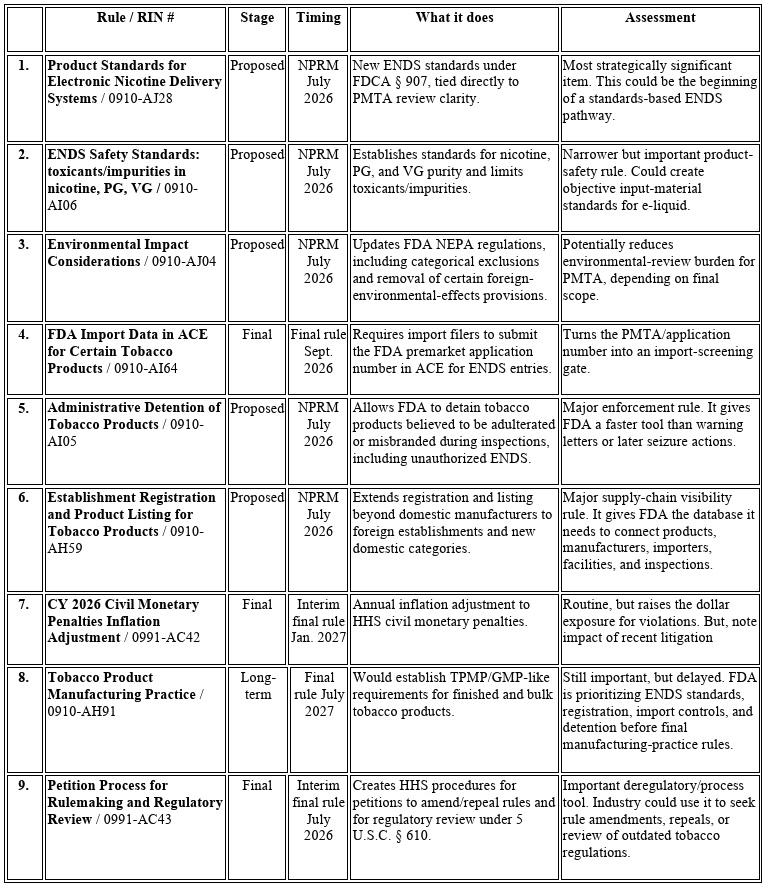
Below is a table summarizing the rules discussed herein that are on the Unified Agenda.
Table of Tobacco / PMTA Related Rules on Unified Agenda
THIS DOCUMENT IS NOT INTENDED NOR SHOULD BE RELIED ON AS LEGAL ADVICE. PLEASE CONSULT LEGAL COUNSEL ABOUT YOUR SPECIFIC PRODUCTS.
Make a Difference
Now is the time to Join the Fight with us by becoming a member.
 Join As An Individual
 Join As A Business


