

VTA REGULATORY ALERT: Requested Actions on Barring E-Cigarettes Conflicts with New FDA Enforcement Guidance
Published on July 17, 2026
Dear Mr. McInerney, Mr. Miebach, Mr. Squeri, and Mr. Fairbank:
I write on behalf of the Vapor Technology Association (VTA), the U.S. trade association representing the interests of manufacturers, distributors, wholesalers, retailers and consumers of nicotine vaping products – regarding action which your companies have been asked to take to bar payment processing services to businesses selling electronic nicotine delivery systems (ENDS), also known as e-cigarettes or vapes. The request for action made in an April 14, 2026 letter your General Counsel from a group of State Attorneys General (the “State AG Letter”) directly conflicts with the recently announced FDA policy and strategic objectives.
The State AG Letter advised your counsel that there are only 45 ENDS products which have been authorized by FDA, and can be legally sold, and tasked your companies with helping them end the sale of all other products not on the FDA’s authorized list. In actuality, the list of authorized ENDS commercially available is significantly smaller.1 Given the paucity of the list and that it does not represent what 90% of American vaping consumers are using, the actions requested of you are tantamount to a category ban drawing your company into a politically charged debate.
Brief Background on Vaping Regulation
The State AG Letter argues that all tobacco products are illegal under the 2009 Tobacco Control Act (TCA) unless first authorized by the FDA. At first blush, this simple, accurate statement is compelling. But nothing is ever simple, particularly in the world of tobacco regulation. Vaping products were not covered by the TCA when it was passed. Because they were widely available on the market, for many years before they first became regulated as tobacco products and subject to the premarket requirements of the TCA, the regulation which made vaping products subject to those requirements necessarily permitted products to remain on the market as the regulatory process unfolded. Hence, during the entire time that vaping products have been on the market, companies using your services have been selling these products without premarket authorization due to their being unregulated, or by design of subsequent federal regulation, or by court orders, and/or pursuant to FDA’s exclusive enforcement discretion. This begs the question of why such dramatic action is asked of you now when the same request could have been made at any time in the past eight years?
The State AG Letter suggests “youth exploitation” should justify your action because products are “colorful” and “flavored.”2 Yet, despite this, the youth vaping rate plummeted 74% to “historic lows” after President Trump raised the age to purchase all tobacco products to 21 back in 2019 (a commonsense law championed by VTA), and youth vaping is essentially disappearing according to the FDA’s most recent data.3 Further, the State AG Letter raises the specter of “criminal enterprises” to justify your action. Yet, there is one guaranteed result of eliminating the most popular flavored vaping products used by 25 million Americans: a black market run by Mexican cartels which are already filling the void created by Mexico’s vape ban.4 Also, the State AG Letter raised questions about product safety. Yet, the scientific debate is over: vaping products are dramatically safer than cigarettes and the most effective tool available to help Americans quit smoking.5
VTA recognizes and shares the core concerns reflected in the State AG Letter: youth access must be prevented, deceptive or youth-oriented marketing should not be tolerated, and bad actors should be the focus of serious enforcement. Responsible companies have a strong interest in a lawful, transparent, and well-regulated marketplace. Yet, due to a series of ideological actions by the prior Administration, the ENDS marketplace has not been well-regulated, and companies have had to contend with changing rules, changing requirements, unlawful denials, and histrionic narratives that paint a dramatically inaccurate picture of the product category and industry.
Thus, President Trump made a campaign promise to save flavored vaping, just as he did in 2019.6
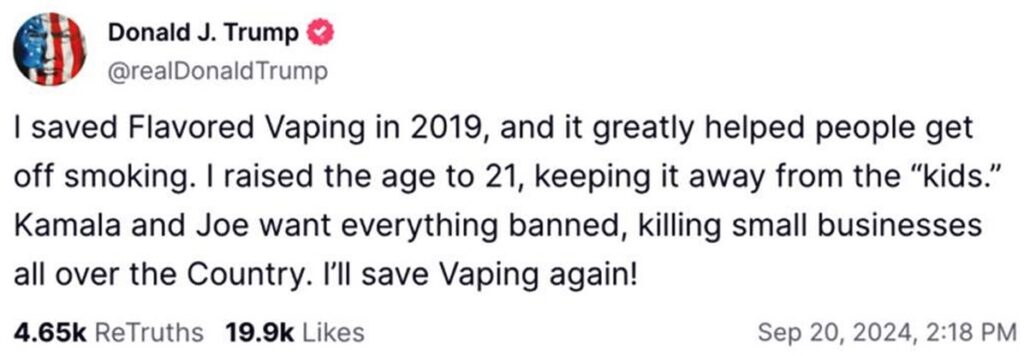
In its second term, the Trump Administration has been working to fix the broken regulatory system it inherited, save vaping, protect consumers, protect youth, and protect an industry which generates more than $33.0 billion in total economic impact in the U.S.
Action Based on the AG Letter Conflicts with the Administration’s Goals and FDA Regulation
In early May, President Trump made clear that FDA needed to move faster to save flavored vaping products.7 As a result, on May 8, 2026, FDA announced a major enforcement policy declaration in a final guidance entitled Enforcement Priorities for Certain New Tobacco Products Marketed Without Premarket Authorization.8 The new regulatory guidance makes clear that FDA does not and will not treat the list of authorized products as the sole determiner for whether products should remain on the market pending review of the products’ applications by FDA. Instead, the guidance identifies a clear federal strategy making the request of the State AG Letter both unnecessary and in direct conflict with the Administration’s and FDA’s actions and goals.
First, FDA stated it will not prioritize enforcement of the premarket authorization requirement for certain ENDS products and described those specifically. FDA announced that “to promote transparency to consumers, retailers and other industry stakeholders…, FDA will create and maintain a public-facing webpage identifying manufacturers and associated products that FDA generally does not intend to prioritize enforcement against.” When published, FDA’s new list will be dramatically different than the impoverished list on which the State AG Letter directs you to rely.
Second, FDA stated it would prioritize enforcement to protect youth and ensure safety, both concerns raised in the State AG Letter to spur action by your companies. Regarding youth, FDA will focus on products with “presumptively underage-appealing elements such as depicting a cartoon-like fictional character, disguising its nature as a vaping product, or resembling a children’s toy, phone or gaming platform.”9 Regarding safety, FDA will focus on products which present “significant public health or safety concern than generally presented by ENDS” and provided various examples.
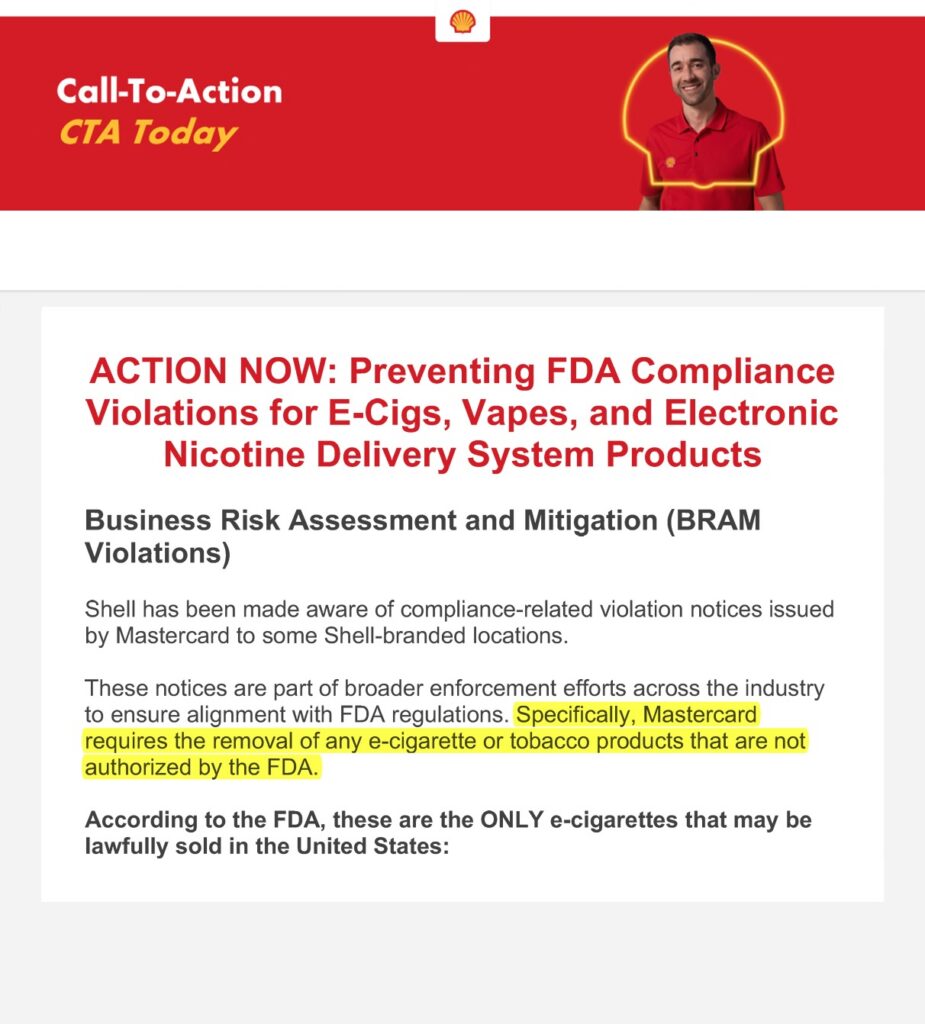
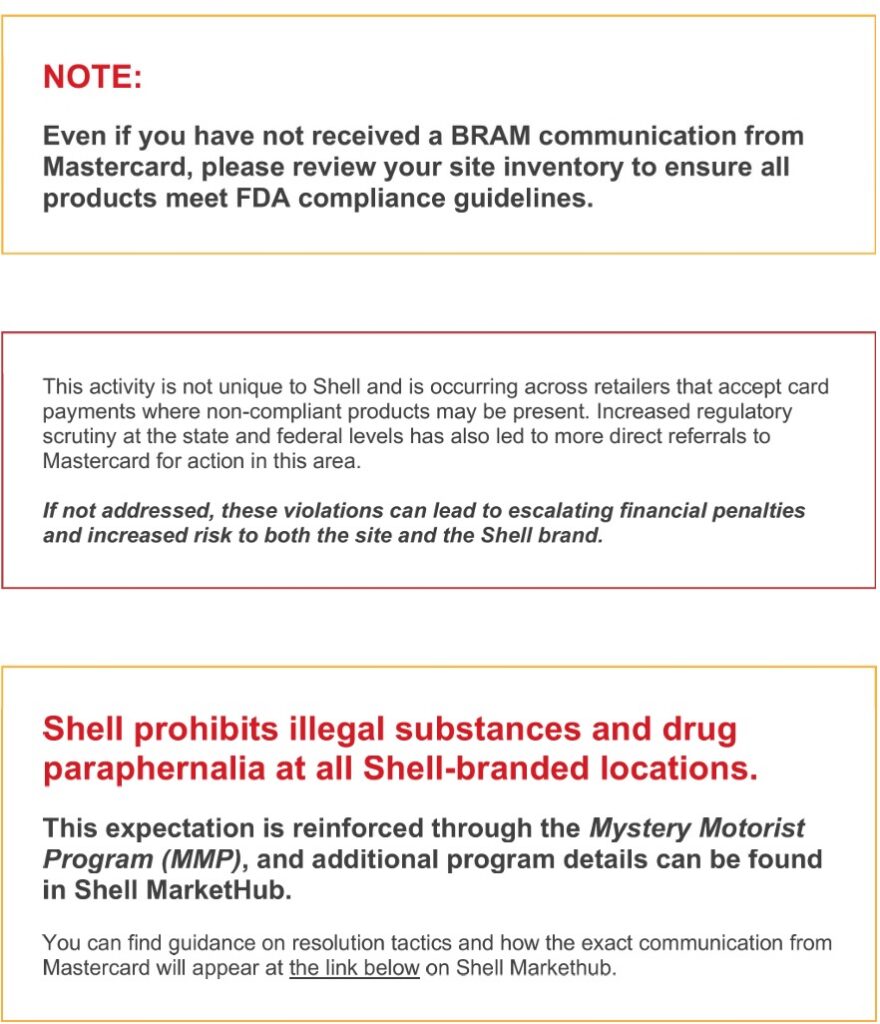
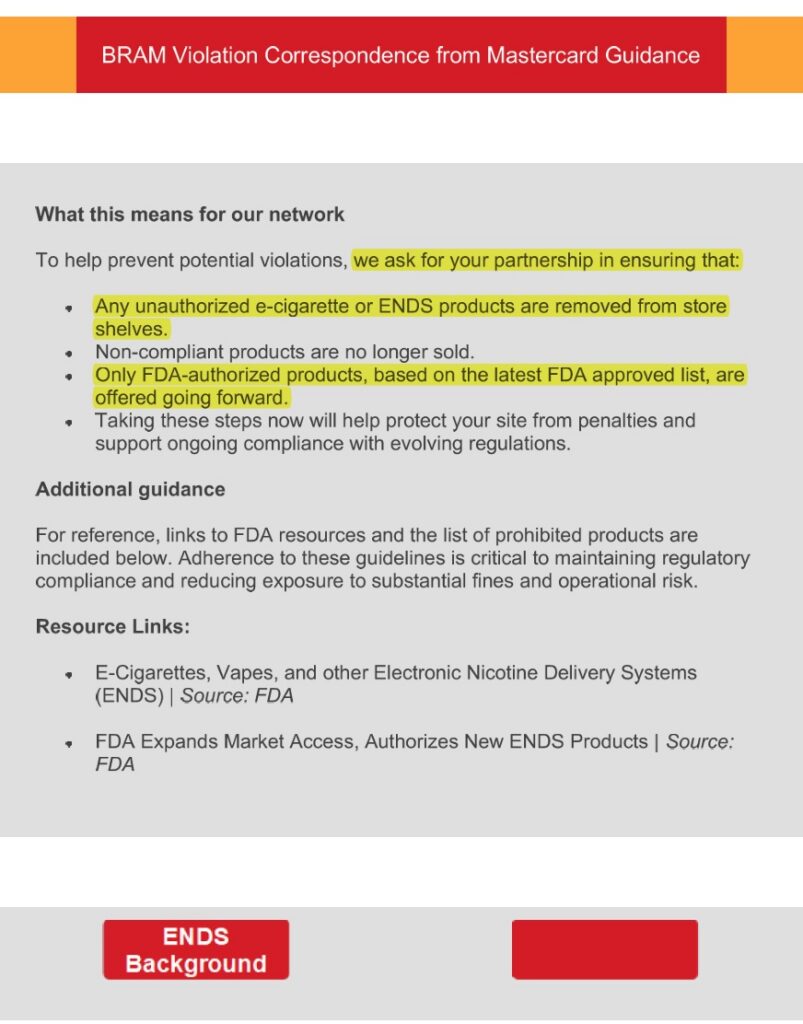
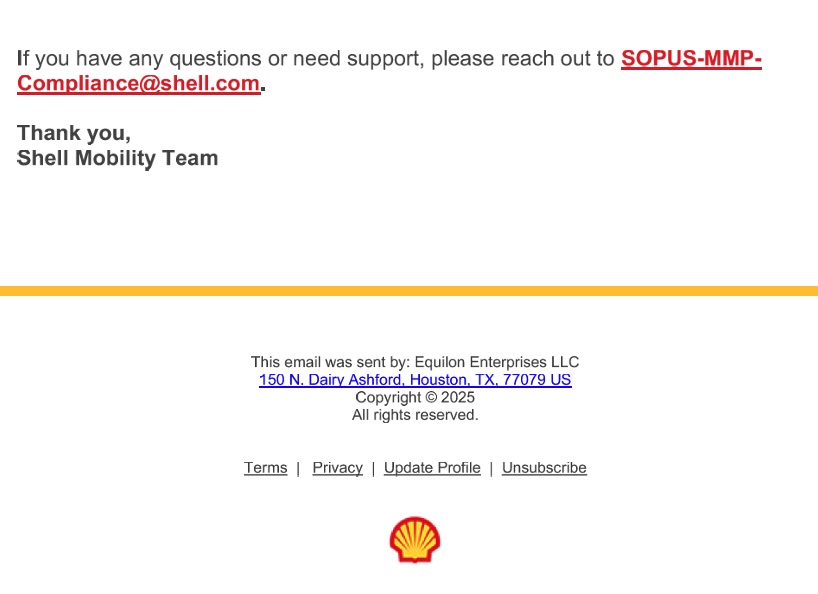
As such, the blunt action requested of you in the State AG Letter bears no resemblance to the strategic and surgical approach being taken by the Administration and the FDA. Very simply, the broad sweeping action requested not only conflicts with the FDA’s declared policy and strategy, but it will undermine Administration efforts to save vaping. To be sure, the action taken by Mastercard already has caused major retailers such as Shell, BP/Amoco and others, to precipitate a frenzy to remove of all vaping products from retailer shelves (save the handful of devices on FDA’s authorized list). (See, e.g., attached Shell BRAM Notice.) These actions are removing not just problematic products but indiscriminately removing all products including those sold by companies that are actively engaged in FDA’s compliance process and products which the FDA itself has said are deserving of enforcement discretion during the compliance process.
Also, you should be aware that your companies are being unwittingly drawn into a contentious political debate over consumer choice. There are 25 million adult consumers who are purchasing vaping products. Market data shows that more than 90% of adult consumers are purchasing flavored ENDS products that are not on the FDA authorized list. Vaping consumers are very protective of their right to choose because quitting smoking is extremely difficult and individualized – they want what works for them. Similarly, vaping voters are highly engaged in defending their rights and strongly disfavor vaping bans or being told what they can and cannot use. In this regard, given the paucity of e-cigarette products on the “FDA-approved list,” your restricting businesses to this list is tantamount to a ban on the flavored e-cigarettes which tens of millions of adult customers are using as their preferred alternatives to smoking deadly cigarettes.
Moreover, the downstream implications of effectively supplanting the FDA’s enforcement decisions with your own will have a dramatic adverse impact on the small businesses that President Trump committed to saving, not to mention steep adverse economic consequences when small businesses are fined out of business or brand owners have so much inventory removed they must cease operating.
For those companies which have not yet acted, we encourage you to exercise caution and wait for FDA to complete its work and publish its enforcement discretion list. This will allow your company to know precisely which products present genuine compliance risk, align your company with current federal regulatory policy on enforcement, and preserve your ability to take targeted action. At the same time, it will avoid unnecessary disruption to your licensed, taxpaying American small business customers and your millions of adult consumer customers, and will ensure that the products FDA itself has determined should receive enforcement discretion remain available.
For those companies which have already acted, we strongly urge you to immediately reverse your announced policy, until the FDA completes its work and publishes its enforcement discretion list. This will realign your company with the current federal regulatory enforcement scheme, protect your millions of consumers, and attenuate the serious marketplace disruption you have caused.
This is a national issue governed by federal regulations. States have myriad options to change their laws and restrict markets. But, your companies should not be the tool used to effectuate non-legislated bans, particularly those that conflict with federal regulations and state laws, and when there is no urgency that is not already being addressed by the Trump Administration and the FDA.
Thank you for your time in considering this matter. We would welcome the opportunity to provide additional information and work constructively with you in addressing this important, complex and evolving regulatory environment.
Sincerely,
Tony Abboud Executive Director
Enclosure
1Most of the authorized products are antiquated (8-15 years old), are widely unavailable on or already removed from the market, or barred from the market due to patent litigation. And since virtually none are flavored e-cigarettes, the list is largely irrelevant to the consuming public.
2This same argument could easily apply to the myriad colorful and flavored alcoholic beverages that have flooded the market, which are used by youth at dramatically higher rates than vapes, and for which your services remain available.
3FDA, FDA Publishes Peer-Reviewed Journal Article, Releases 2025 Youth Tobacco Findings, June 23, 2026. 4Verza, Maria, After Mexico bans vapes, cartels tighten grip on booming market | AP News, January 30, 2026,
5It is worth noting that your services remain readily available for businesses to sell and consumers to buy cigarettes, a legal product which when used as intended kills half a million Americans every year, making it the number one cause of death and disease in the U.S. 6In 2019, President Trump executed a targeted action directed at the flavored products that all the kids were using and he exempted from that partial flavor ban the very products you are now removing from your store shelves today.
6In 2019, President Trump executed a targeted action directed at the flavored products that all the kids were using and he exempted from that partial flavor ban the very products you are now removing from your store shelves today.
7Choi, Joseph and Weixel, Nathaniel, FDA drops guardrails on vaping industry in major Trump pivot, The Hill, May 18, 2026, available at https://thehill.com/policy/healthcare/5880802-flavored-vapes-fda-guidance/.
8FDA, FDA Issues Guidance on Enforcement Priorities for Unauthorized ENDS and Nicotine Pouch Products, May 8, 2026, available at https://www.fda.gov/tobacco-products/ctp-newsroom/fda-issues-guidance-enforcement-prioritiesunauthorized-ends-and-nicotine-pouch-products.
9One year ago, VTA loudly called on the Administration to take this action. VTA Press Release: One-Million-Dollar Ad Campaign Launched by VTA Urging Immediate Action to Remove Youth Targeted Vapes, July 14, 2025.
THIS DOCUMENT IS NOT INTENDED NOR SHOULD BE RELIED ON AS LEGAL ADVICE. PLEASE CONSULT LEGAL COUNSEL ABOUT YOUR SPECIFIC PRODUCTS.
Make a Difference
Now is the time to Join the Fight with us by becoming a member.
 Join As An Individual
 Join As A Business


