Vapor Technology Association
Sign In Sign In Sign Out Sign Out
  • Home
  • About
    • About VTA
    • Priorities
    • Governance
    • Industry Marketing Standards
    • FAQ
  • American Impact
  • Membership
  • Action Center
  • News

Vapor Technology Association Vapor Technology Association

Join Today Dashboard
  • Home
  • About
    • About VTA
    • Priorities
    • Governance
    • Industry Marketing Standards
    • FAQ
  • American Impact
  • Membership
  • Action Center
  • News

The FDA is Objectively Failing

August 29, 2024 by Black Development

With over 16 million Americans suffering from smoking related disease, and nearly 500,000 Americans dying annually, the FDA’s Center for Tobacco Products has chosen to use its enormous regulatory power to deprive Americans of access, if not outright ban, all non-combustible alternatives to cigarettes in the U.S. despite leading tobacco control researchers demonstrating they are the most effective tool available to help people quit smoking.

“It is now time for the medical community to acknowledge this progress and add e-cigarettes to the smoking cessation toolkit… U.S. public health agencies and professional medical societies should reconsider their cautious positions on e-cigarettes for smoking cessation. The evidence has brought e-cigarettes to the tipping point. The burden of tobacco-related disease is too big for potential solutions such as e-cigarettes to be ignored.”

Dr. Nancy Rigotti, Harvard Medical School

Only a few years ago –  regulators, scientists and harm reduction advocates arrived at a policy consensus that would balance the relative risks posed by various tobacco products. That consensus was driven by shared goals – to reduce the number of Americans who smoke cigarettes and move them down the “continuum of risk” away from combustible tobacco and toward less risky alternatives especially vaping and other non-combustible nicotine products. The most recent government data that tracks progress in this regard is unfortunately telling us that FDA policies are risking the lives of many Americans – especially older Americans who are most at risk from continuing this deadly habit.

In August of 2021, the 15 past presidents of the staunchly anti-tobacco Society for Research on Nicotine and Tobacco published a groundbreaking essay in the American Journal of Public Health. In it, they encouraged a more balanced consideration of vaping and other alternative nicotine products within public health and in the media and policy circles. While acknowledging that vaping is not free from risks, they demonstrated that it is substantially less harmful than cigarette smoking. Furthermore, they highlighted emerging evidence showing that vaping can increase smoking cessation and is likely more effective than FDA-approved nicotine replacement products like gum and patches. 

Two years later, the FDA echoed some of those same observations and recommendations. In an August 2023 commentary published in the online journal Addiction and authored by Brian King, the current head of FDA’s Center for Tobacco Products (CTP), King highlighted that many adults were misinformed about the relative risks of various tobacco products and that misunderstanding was a barrier to moving smokers down the continuum of risk toward safer, non-combustible tobacco products. And yet, the CTP during his tenure  has  authorized a mere handful of non-combustible nicotine products. Instead, CTP has authorized thousands of new combustible tobacco products. As a result, millions of Americans continue to smoke and die from tobacco related disease.

American Smoking Deaths Under the Califf/King FDA

Since February 17, 2022

830,000,000

For an agency that spends a great deal of time talking about saving lives, by every empirical measure, they are objectively failing:

  • During the period that Brian King and FDA Chief Robert Califf have been in charge of tobacco policy for the country, FDA has authorized more than 1,500 new cigarettes and more than 11,000 combustible tobacco products
  • According to the 2023 National Youth Tobacco Survey (NYTS), past 30-day cigarette use among 12th graders, INCREASED from 5.7% to 7.5%
  • The independent Reagan-Udall Foundation criticized the FDA for putting politics over science and ignoring emerging evidence that confirms that flavor bans and other prohibitions on non-combustible nicotine products actually increase cigarettes sales
  • FDA’s own tobacco enforcement statistics confirm that smoking remains a problem and that youth smoking violations are higher than youth vaping
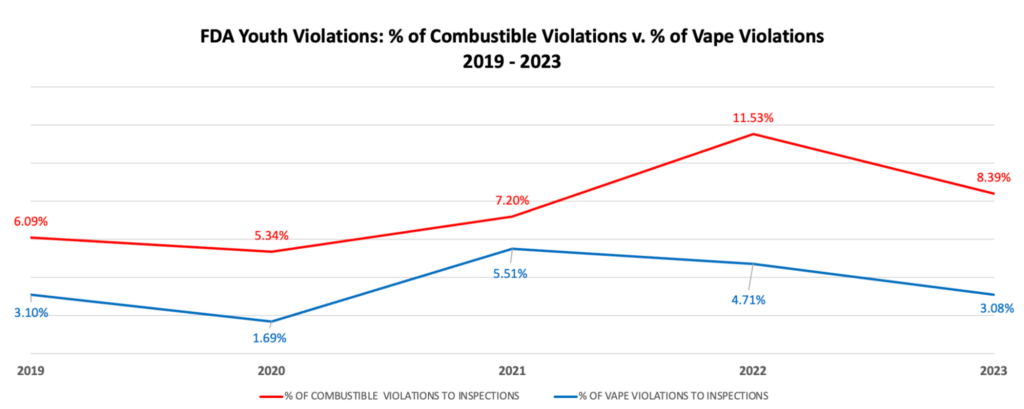
Scientists are now starting to sound the alarm and are warning that we have reached a tipping point where FDA’s broad opposition to flavored non-combustible tobacco products over the last four years will create enormous public health consequences in the future for many Americans. 

Dr. Nancy Rigotti, Professor of Medicine at Harvard Medical School and a member of the National Academies of Science Engineering and Medicine, has sounded the alarm after publishing a editorial stating that we have reached “the tipping point” where policymakers can no longer willfully ignore evidence and use their regulatory authority to undermine e-cigarettes. 

“It is now time for the medical community to acknowledge this progress and add e-cigarettes to the smoking cessation toolkit… U.S. public health agencies and professional medical societies should reconsider their cautious positions on e-cigarettes for smoking cessation. The evidence has brought e-cigarettes to the tipping point. The burden of tobacco-related disease is too big for potential solutions such as e-cigarettes to be ignored.”

FDA now finds itself in the awkward position of being a health agency that is facilitating the sale of cigarettes thereby undermining its own mission to reduce the incidence of smoking related disease and death. FDA’s policies are keeping more effective (and safer) alternatives to cigarettes away from consumers and are in turn propping up the sales and profits of big tobacco companies. Without a course correction that truthfully portrays the risks and benefits of various nicotine products, millions of Americans will needlessly suffer from illness and death.
Filed Under: Government Updates, News

VTA Response to CTP 5 Year Strategic Plan

December 19, 2023 by Tony Leave a Comment

The Vapor Technology Association has reviewed the U.S. Food and Drug Administration’s (FDA) Center for Tobacco Products (CTP) five-year strategic plan. In short, VTA is deeply disappointed with the plan’s lack of substance and absence of specifics to move American smokers off of combustible products towards effective harm-reduction nicotine options.

In October, at the Food & Drug Law Insitute’s Tobacco and Nicotine Policy Conference in Washington, D.C., VTA called on FDA to make harm reduction the “north star” of the strategic plan. The plan that has now been released lacks any commitment, much less a clear roadmap, to aggressively move people who smoke towards non-combustible forms of nicotine. It speaks vaguely about the importance of health equity and insists that a primary focus of CTP remains on reducing tobacco-related death and disease – but provides no insight, details, or specific methods by which CTP will achieve this. Nor does it acknowledge the latest science in support of e-cigarettes as the most effective non-combustible option for smoking cessation.

Most concerning is that CTP’s strategic plan fails to even attempt to address the Reagan Udall Foundation’s (RUF) central and most damning criticisms that go to the core of CTP’s job:

  1. that CTP has not clearly met the most basic elements of its tobacco and nicotine regulatory program by defining what is required of applicants under the “Appropriate for the Protection of the Public Health” (APPH) standard in the Tobacco Control Act, and
  2. that CTP has not clearly explained how it is assessing the science to determine what is APPH.

The silence of CTP’s strategic plan on these issues is defeaning. By failing to address these core criticisms, CTP’s five-year strategic plan will continue to generate misinformation, inefficiency, litigation, and suspicions of political interference.

VTA has repeatedly called on CTP to speak immediately, loudly, and repeatedly to adults about tobacco harm reduction in order to start saving lives now. Instead, CTP mentions the notion of conducting “foundational” and “formative” research on whether it might speak to adults – at some unknown time in the future – about harm reduction and less harmful vaping and other nicotine alternatives. Meanwhile, 480,000 people die prematurely every year from cigarette smoking.

The release of CTP’s five-year strategic plan, which took a full year to construct, was an opportunity to demonstrate bold, not bureaucratic, leadership on tobacco harm reduction that could close the deadly chapter of cigarettes in America. Instead, what the American public was given is document that reflected little more than a commitment to bureaucracy without any real direction or goals, much less a strategy to achieve those goals. Only 15 of the 27 pages of government pabulum (littered with pictures, graphics, and process tables) could actually be considered a recitation of the “plan” but, in total, it revealed nothing more than a “check the box” exercise (which failed to even check the most important boxes).

The strategic plan was a huge missed opportunity for the bureacracts to stand up for science and tobacco harm reduction, and stand up for the millions of smokers in vulnerable Black, LGBTQ+, and low income popluations who would benefit the most from a plan that actually kickstarted the important work of improving and saving lives and reducing or eliminating smoking related diseases. Instead, CTP demonstrated that its hands are firmly gripped upon a wheel that it is refusing to turn as it careens off a public health cliff with the lives of American smokers in tow.

Filed Under: Government Updates, News, Press Releases

NYTS 2023 – VTA Calls on FDA to Approve Flavored E-Cigarettes for Adult Tobacco Harm Reduction After Another Massive Drop in 2023 Youth Vaping Rate

November 2, 2023 by Ethan D'Souza Leave a Comment

WASHINGTON – November 2, 2023 – The Vapor Technology Association (VTA) today called on the U.S. Food and Drug Administration’s (FDA) Center for Tobacco Products (CTP) to immediately start communicating with adult smokers about the scientifically proven harm reduction and smoking cessation benefits of e-cigarettes and start approving a wide variety of e-cigarettes, including flavored products. Study after study has shown that flavored e-cigarettes are proven to be the most effective products available on the market to help adults reduce their use of combustible tobacco or quit altogether. 

The call from VTA comes after newly released 2023 National Youth Tobacco Survey (NYTS) data from the U.S. Centers for Disease Control and Prevention (CDC) revealed that the U.S. youth vaping rate dropped another 4 percentage points from 2022 and now sits at 10% – the lowest level in more than a decade even amid broad availability of flavored vapes in the market. 

According to CDC data from 2019 and 2023, the youth vaping rate in the U.S. plunged a massive 61% since it peaked in 2019. 

“While last year’s dramatically reduced youth vaping figure justified the CTP’s decision to stop referring to youth vaping as an ‘epidemic,’ this latest 2023 NYTS data validates CTP’s decision,” said Tony Abboud, executive director of the Vapor Technology Association (VTA). “It is now clear that any claim about a persistent youth vaping epidemic in the U.S. can only be considered anti-scientific.” 

The youth vaping rate has fallen to a 10-year low despite the continued availability of flavored nicotine vaping products. This fact fundamentally rejects the misinformation refrain spread by regulators and activists that flavors drive youth vaping. 

Year after year, the CDC NYTS survey has revealed that flavors are not even one of the top six reasons youth vape, with a mere 6.4% of youth citing flavors as the reason they vape in the CDC NYTS 2022 survey. However, the CDC did not disclose the answer to this question in this year’s survey and instead chose to fill its report with a variety of details related to youth use that have nothing to do with why they vape – a critical part of past surveys.

“Because youth vaping continues to plummet despite the wide availability of flavored products, and because flavored e-cigarettes have been proven to help adult smokers quit, it’s time for the FDA to acknowledge and promote their benefits for adult smokers,” continued Abboud. “This year’s NYTS data is a clear sign that FDA actions, which have been myopically focused on denigrating flavored e-cigarettes to ‘protect youth’ are dangerous and misinformed.”

“In light of these latest findings, VTA renews the call it made at last week’s Food and Drug Law Institute Tobacco & Nicotine Policy conference for CTP to acknowledge the dramatically reduced youth vaping rate – now even lower – and immediately start educating adult smokers about the fact that vaping is dramatically safer than smoking and encourage smokers to use or even try e-cigarettes if they can’t quit if they can’t quit another way,” said Abboud.

VTA also encourages regulators to work with it and finally adopt the series of marketing reforms and youth access restrictions that will further drive down youth vaping while ensuring that a wide variety of flavored vaping products remain available and accessible to adult smokers through adult-only stores.

FDA’s policies are leaving behind American smokers. Smokers are increasingly over-represented in marginalized black, low-income, low-education, and LGBTQ+ communities and continue to die at unacceptable rates. These communities deserve to hear the truth about how to lower their risk and improve their chances of quitting smoking. According to a recent report from the Center for Black Equity, the “broad approval of flavored vaping products will save Black and LGBTQ+ lives, reduce smoking, and drive meaningful progress in lowering preventable cancer rates.”

“Americans need real solutions and information, not bureaucratic posturing around big data,” concluded Abboud. “Every year the FDA remains wedded to its prohibition mentality and keeps the public in the dark about the benefits of flavored e-cigarettes, millions of Americans will continue to smoke, suffer, and die.”

Media Contact
press@vaportechnology.org

About VTA

The Vapor Technology Association is the U.S. industry trade association whose members are dedicated to sound science-based regulation and selling innovative high-quality vapor products that provide adult smokers with a better alternative to combustible cigarettes. VTA represents the industry-leading manufacturers of vapor devices, e-liquids, and flavorings, as well as the distributors and retailers, including hardworking American mom-and-pop brick-and-mortar retail store owners.

Also Read FDA’s Center for Tobacco Products Must Reverse Course to Quickly Reduce Smoking Harms

Filed Under: Government Updates, News

FDA’s Formal Position on Enforcement Discretion Revealed

March 8, 2023 by Tony

VTA presses CTP on clarifying enforcement discretion policy

The “million dollar” question: CTP has historically allowed all tobacco products with pending pre-market tobacco applications (PMTAs) to remain on the market, subject to FDA’s enforcement discretion, but in the past few months has been making confusing statements particularly with respect to non-tobacco nicotine (NTN) products, also known as synthetic nicotine products. Following up on VTA correspondence from early November 2022, we asked Director King directly during our January 10, 2023 meeting: “Has CTP had changed its well-established enforcement discretion policy for non-tobacco nicotine products only?”

What we said: It’s extremely important that we get clarity on this question so all market participants understand CTP’s position and so that companies are not able to misrepresent CTP’s position for their own benefit.

  • For years, CTP has used enforcement discretion to allow all tobacco products with pending PMTAs to remain on the market and that policy should be consistently applied to tobacco-derived and non-tobacco derived nicotine products alike.
  • CTP has exercised enforcement discretion for years. CTP has asked courts not to limit its enforcement discretion. CTP has explained its actions or inactions based on enforcement discretion.
  • Some companies have been attempting to confuse retailers and dissuade them from carrying synthetic nicotine products by claiming that CTP uses enforcement discretion only for tobacco-derived nicotine products and not for synthetic nicotine products.
  • Nothing in the new law limited CTP’s enforcement discretion – in fact, CTP has been exercising that discretion – and CTP would never unilaterally limit its own discretion.

What FDA said: During the January 10 meeting Director King indicated that had been no policy change with respect to CTP’s use of enforcement discretion.  Director King promised a formal letter soon from CTP in response to VTA’s questions to clarify CTP’s position.

King to VTA: FDA has no enforcement discretion policy for TDN or NTN products!

VTA received a letter from Director King on February 2, 2023 outlining CTP’s formal position on enforcement discretion regarding tobacco-derived nicotine (TDN) and non-tobacco/synthetic nicotine (NTN) products.

About Face: The formal response letter promised from Director King stated, among other things, that:

  • TDN products are not being treated differently than NTN products.
  • CTP has not been using enforcement discretion for tobacco-derived nicotine products or synthetic nicotine products.
  • All products, regardless of whether they include tobacco-derived nicotine or synthetic nicotine, are illegal and cannot be sold unless and until their PMTAs have been authorized.

Go deeper: While CTP has always acknowledged that FDA was using its enforcement discretion, that has changed. Here is how CTP recasts its historical and current position:

“Accordingly, your letter’s assertion that FDA is “us[ing] its enforcement discretion to allow…products to remain on the market” while they undergo review is not correct. On the contrary, as the guidance reiterates, all illegally marketed TDN e-cigarette products are subject to FDA enforcement. The same principle applies to NTN products; specifically, all illegally marketed NTN products are subject to enforcement.”

“FDA cannot affirmatively allow or permit the unlawful marketing of tobacco products, including TDN and NTN e-cigarette products; as the above statements reflect, all illegally marketed products are subject to FDA enforcement, such a seizure, civil money penalty, or injunction. Moreover, FDA has not adopted a broad policy of enforcement discretion with respect to TDN or NTN e-cigarette products that lack the required premarket authorization.”

Why Now?

  • Sure, VTA has been pressing CTP on clarifying the question of enforcement discretion for months.
  • But, it is worth noting that CTP’s letter (three months in the making) was received just one day after Sen. Richard Durbin (D-IL) and other Senators issued another yet another press release and sent a letter to HHS Secretary Xavier Becerra blasting CTP for its, yes, “exercise [of] enforcement discretion,” and demanding “This enforcement discretion should have ended years ago. It must end today.”
  • According to CTP’s letter, they have never been using and are not using enforcement discretion for any nicotine-containing product.

Takeaway. As far as the FDA is concerned, every nicotine product that is on the market without having already received a PMTA authorization (even if that PMTA is still being reviewed by FDA) cannot be marketed. And, there is no enforcement discretion preference for tobacco-derived nicotine products as compared with non-tobacco/synthetic nicotine products. They are all in the same boat from FDA’s perspective.

VTA Letter to King
King Letter to VTA

Filed Under: Government Updates, News

Here’s Why the FDA’s Vaping Policy Should Change

October 21, 2022 by VTA Editors

Comments of the Vapor Technology Association

Presented by Tony Abboud, Executive Director

INTRODUCTION

Good morning.  The Reagan-Udall Foundation’s mission[1] of “modernization,… accelerating innovation and enhancing product safety” could not be better applied to any other product category within the FDA’s ambit of authority than less harmful nicotine products.

This review couldn’t have come at a more important time and Commissioner Califf should be applauded for calling for it and Director King should be applauded for embracing it. FDA’s new leaders have an historic opportunity to dramatically change public health in the U.S. by boldly correcting errors of the past, eliminating political interference in the scientific process, providing a clear roadmap for the approval of less harmful nicotine products, and accelerating innovation away from the deadliest product on the market – the combustible cigarette.

But, this will not happen, if at all, at a fast enough pace to save the lives of millions of Americans who still smoke cigarettes unless serious process changes are made.

What has the Agency done well?  

You have asked us to address three components and I will start with what the FDA has done well.

  1. In 2017, Commissioner Gottlieb announced a Comprehensive Plan for addressing tobacco and nicotine issues.  Foreseeing the challenges of PMTA compliance, Gottlieb extended the deadline for filing from 2018 to 2022 since the agency still needed to “issue foundational rules to make the product review process more efficient, predictable, and transparent for manufacturers.” The comprehensive plan also expressly acknowledged the continuum frisk and that ENDS products fall at the lower end of the risk continuum when compared to cigarettes.
  2. CTP issued an ANPRM on the important issue of flavors to examine their impact on initiation and on smoking cessation.
  3. CTP has effectively administered its Substantial Equivalence application process for reviewing new tobacco products.  

What has the Agency not done well?

Unfortunately, these positive steps have not led to the successful execution of CTP’s mission.

Since January 2020, CTP’s efficient management of the SE process has bizarrely resulted in the authorization of 600 new combustible tobacco products, 250 of which are new cigarettes. In contrast, FDA’s management of the PMTA process has authorized only 6 less harmful ENDS devices, some of which are antiquated technologies and/or have virtually no market presence.  How did this happen?

First, the FDA abandoned its Comprehensive Plan and did everything but create the “efficient, predictable, and transparent” process Gottlieb said was necessary. 

CTP never finalized the “foundational rule” for PMTAs before applications were filed and it acquiesced to a 2-year acceleration of the filing deadline notwithstanding the unavailability of that final rule. This forced companies to rely on non-binding guidance, rush scientific research and data collection, submit redundant applications, and conduct unnecessary testing. 

Second, CTP failed to apply the continuum of risk in its comparative assessment of ENDS to cigarettes and also failed to distinguish between open and closed ENDS products.

Third, CTP abandoned its ANPRM on flavors in 2018, ignoring the enormous body of science presented by all stakeholders, including VTA’s substantive review of all flavor studies.

Fourth, CTP altered its review process and standards AFTER applications had been accepted for substantive review, using those changes to deny countless PMTAs all without conducting that substantive review, and failed to balance all the prongs of the APPH test, choosing instead to use single alleged deficiencies to deny applications.

These actions plunged the entire category into chaos and CTP’s decisions into protracted litigation.

This was all driven by an exclusive focus on youth and flavors which has been directly criticized by the 15 past presidents of SRNT, the most esteemed group of tobacco-control scientists, as threatening the chances of adult smokers to quit. I’ll briefly explain one example of how the Agency’s prior interim leadership allowed outside influences to subvert the PMTA scientific process on this issue alone.  

Flavor Example

In August 2020, CTP’s Office of Science documented its process for reviewing applications for flavored ENDS products and explained that it anticipated approving such products as APPH.  At a June 11, 2021 public meeting, the Office of Science transparently explained the process and priorities it was using to review PMTAs.

Two weeks later, when FDA’s Acting Commissioner Woodcock testified before a Congressional committee on June 23, committee members demanded that Woodcock deny JUUL’s PMTAs and deny any flavored e-liquid PMTAs claiming thatwas her responsibility regardless of the science.

Immediately after the hearing, I learned from those inside the FDA that Woodcock injected herself on the  flavor issue. Two weeks thereafter, CTP documented Woodcock’s interjection in a now infamous July 9 “fatal flaw” memorandum, explaining that the Office of Science was “tasked” by the Acting Commissioner to implement a “new plan” to “take final action” on as many flavored ENDS applications as possible – a complete reversal of both the process and priorities they announced less than one month earlier.

The memorandum articulated a review process which imposed a new testing prerequisite, 11 months after the applications were filed. CTP created a new “presumption” that all flavored products are attractive to youth to justify the new requirement for long-term product specific studies on cessation and a heightened standard for flavored ENDS.  CTP’s scientists were forced to alter their process to ensure the blanket rejection of virtually all flavored applications and did so without even reviewing the applications and science submitted.  The process change effectuated a de facto policy change and as it was unfolding in September 2021, I heard from people inside FDA who were stunned that the Agency had changed its position “without any scientific support.”

This leads me to recommendations.

RECOMMENDATIONS

  1. CTP must implement safeguards to ensure that the review process is free of external pressures. I have only highlighted one of many examples. Unless the process is insulated, CTP will never be allowed to execute its mission.
  2. Unapologetically follow the science and announce approvals.  The Office of Science must be allowed to complete its reviews and when it authorizes applications, those decisions should immediately and loudly be announced to the marketplace. 
  3. Immediately reverse the fatal flaw memo and actually review the science presented.  This means not imposing a non-product-specific presumption regarding initiation (i.e. that ALL flavored products are attractive to youth) while demanding “product specific” data regarding cessation.
  4. Restore the primacy of APPH balancing test. This means treating the cessation and population benefits prong equally to the initiation prong.  This means conducting a holistic review and not singling out one set of data on which it justifies denials.
  5. Use CTP’s enforcement discretion to work companies through the PMTA process.  Virtually all PMTAs have been submitted on grossly accelerated timeframe. Working with companies that can comply with the requirements and providing them the time necessary to complete the required science ensures a stronger process. This particularly applies to FDA’s recently acquired non-tobacco nicotine authority. This also applies to smaller manufacturers who don’t have large scientific staff or resources.
  6. Avoid rejections based on administrative or technical failings.  CTP has refused to accept certain otherwise robust applications because of technicalities. In these cases, reviewers should be authorized to pick up the phone and get those technicalities cured, rather than plunge the agency into protracted and wasteful litigation
  7. Establish defined testing methods.  This should be done for HPHC testing and while ensuring those methods are consistent with normal human use.
  8. Eliminate redundant and unnecessary testing.  For example, biomarker studies and inhalation studies are irrelevant when companies have presented data showing a dramatic reduction (or absence) of toxins.
  9. Use the full scope of its post-marketing order authority. In balancing the APPH, CTP should rely on post-market surveillance and post-market consumer studies to monitor its authorizations and suspend or withdraw a marketing order if it finds new evidence would so justify it.
  10. Equally fund research proposals.  FDA funded research is critical to the review process. To date, the agency has only funded research purporting to identify problems, i.e., youth initiation. CTP should equally fund research on smoking cessation.

CONCLUSION

In conclusion, today, CTP is stuck, trapped if you will, managing a monstrous rule of its own creation.  It needs direction from this Foundation to impose a transparent set of requirements and to ensure strict and fair adherence to science-based decisions.  As a final note, CTP needs to appreciate that the entire application approval process is being made virtually irrelevant due to the Agency’s inability to stop the flow of products into this country from companies ignoring the regulatory process. It is our hope that the Reagan-Udall Foundation’s review will ultimately create an “efficient, predictable, and transparent” process and, in so doing, make real the promise of less harmful nicotine products.


[1] Mission of R/U and mission of the FDA: “The Reagan-Udall Foundation for the Food and Drug Administration is an independent 501(c)(3) organization created by Congress “to advance the mission of the FDA to modernize medical, veterinary, food, food ingredient, and cosmetic product development, accelerate innovation, and enhance product safety.”

Filed Under: Government Updates, News

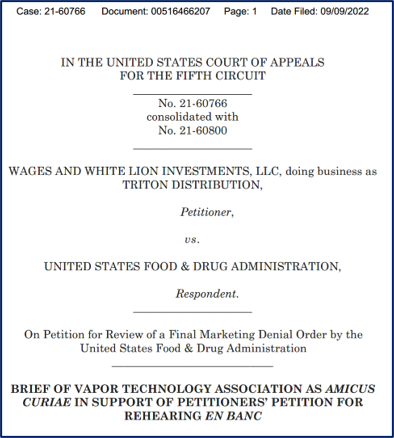
The VTA Supports 5th Circuit Rehearing En Banc with Amicus Brief

September 9, 2022 by Black Development Leave a Comment

5th circuit hearing in the case Wages & White Lion Investments, a/k/a/ Triton Distribution v. FDA.

New Orleans, LA – September 9, 2022  – The Fifth Circuit granted the Vapor Technology Association’s (VTA) unopposed motion to file an amicus brief in support of Petitioners’ Petition for a Rehearing En Banc in the case Wages & White Lion Investments, a/k/a/ Triton Distribution v. FDA.

Recently, a panel of Fifth Circuit judges denied Triton Distribution’s appeal of the FDA’s market denial order (MDO) for its flavored e-liquid products in a 2-1 decision.  Thereafter, Triton filed a Petition for en banc review, asking the entire Fifth Circuit to reconsider the ruling. 

VTA’s amicus brief supports Triton’s request by explaining that it involves issues of “exceptional importance” necessitating review by the entire Fifth Circuit Court of Appeals.   VTA’s amicus brief highlights three key points:

  1. Economist John Dunham & Associates’ evaluation of the adverse economic impact that the ruling would have if it lead to the removal of all flavored open-system vaping products from the states comprising the 5th Circuit (Louisiana, Mississippi, and Texas);
  2. The leading tobacco-control scientists who have warned that removing flavors will deter adult smokers from quitting and have recommended limiting the sale of flavored vaping products to adult-only stores; and
  3. The results of VTA analysis of FDA’s compliance data between 1/1/20 and 6/30/22 which reveals:
    1. The rate of illegal youth sales of cigarettes and cigars are twice the rate of vaping products;
    2. Of all violations for youth vaping sales, only 3.61% occurred in true brick and mortar vape shops with nearly 80% occuring in non-age-restricted facilities; and
    3. 60% of all youth vaping sales violations involved traditional tobacco flavors (tobacco, mint, menthol) with less than 40% involving other flavors which the 5th Circuit’s ruling would adversely limit.

VTA’s full amicus brief + the economic impact report is available HERE.

Filed Under: Government Updates, News

Bloomberg Law Labels Vapor Association as Unlikely FDA Ally

August 4, 2022 by Tony Leave a Comment

DEEP DIVE

The FDA has gained an unlikely ally in its plans to ban menthol cigarettes—a leading vaping trade group that wants to see smokers switch to e-cigarette products.

The agency received hundreds of thousands of comments on its effort to target menthol and other flavored tobacco products that can make smoking harder to quit. The Vapor Technology Association, which represents an industry typically known for its combative relationship with the Food and Drug Administration’s Center for Tobacco Products, says it wants to see the proposal go through, so long as the FDA authorizes more e-cigarettes as an alternative.

“Removing menthol cigarettes from the marketplace is an important step forward, presuming that the agency does what it needs to do in terms of securing and providing alternative products that are legal and authorized and getting them introduced into the marketplace,” VTA Executive Director Tony Abboud said in an interview.

One proposed rule (RIN 0910-AI60) would prohibit tobacco manufacturers and retailers from making, distributing, and selling cigarettes containing menthol as a flavor. The second (RIN 0910-AI28) would ban all characterizing flavors, including menthol, in cigars.

Public health and anti-tobacco groups say the proposals would go far in the FDA’s efforts to reduce negative health outcomes and disparities fueled by products disproportionately used by Black Americans and other minority groups. The FDA has warned that menthol can make smoking more addictive and appealing, especially among youth.

The vaping industry has long framed its products as a way for smokers to transition away from combustible tobacco. But health groups say that offering products as an off-ramp for traditional cigarette and cigar users isn’t part of the FDA’s mandate, and that there’s not enough evidence for the agency to take an official stance on e-cigarettes as a reduced-harm alternative.

The FDA has said it likely won’t be able to complete its review of tobacco-based e-cigarette marketing applications until June 30, 2023—nearly two years after a court-imposed deadline of Sept. 9, 2021. It’s so far authorized 23 electronic nicotine products and recently ordered Juul Labs Inc. to remove its products from the US market, but subsequently stayed that order pending further review.

The agency said in an email that it couldn’t comment on a specific timeline for reviewing public input on the menthol proposals, but added that it plans to “move carefully and quickly in considering all public comments received and determining next steps to protect public health.”

The FDA said it may ultimately “decide to end the rulemaking process, to issue a new proposed rule, or to issue a final rule.”

Harm Reduction

The VTA said in comments to the FDA that it supports the menthol ban in cigarettes, but that it should do more to help adult smokers.

“VTA promotes regulation that can hasten the reduction in smoking cigarettes and that focuses on the critical importance of tobacco harm reduction as an essential public policy objective,” the group said in its letter.

In addition to the proposed ban, the FDA should “simultaneously accelerate the review and approval of menthol vaping products and other flavored vaping products,” Abboud said in an interview.

“If you’re going to take away cigarettes from a large population of consumers that are addicted to those products, you must provide them alternatives,” Abboud argued.

“Otherwise, we fear the worst happens,” he added, noting 2021 research cited by the FDA that estimates nearly 46% of menthol smokers ages 35 to 54 would become non-menthol tobacco cigarette smokers after a ban.

“That is not the best public health outcome that we can have,” Abboud said. “When you think about how popular menthol cigarettes are, the goal is to get them off of cigarettes altogether.”

Youth Risks

Tobacco policy analysts say there isn’t clear evidence that e-cigarettes is a less harmful alternative, and that such benefit must be balanced with the risks that youth will become smokers through vaping.

In 2021, roughly 39% of middle- and high-school smokers in the US reported frequently using e-cigarettes, compared to 19% for cigarettes and nearly 21% for cigars, according to the Centers for Disease Control and Prevention’s annual National Youth Tobacco Survey.

The only people likely to benefit from flavored e-cigarettes as a reduced-harm alternative are current cigarette smokers, Joanna Cohen, director of Johns Hopkins University’s Institute for Global Tobacco Control, said.

“It’s not reduced harm when you’re not using any tobacco product,” said Cohen, who recently served as a voting member on the FDA’s Tobacco Product Scientific Advisory Committee.

Joelle Lester, director of Commercial Tobacco Control Programs at Mitchell Hamline School of Law’s Public Health Law Center, said that while e-cigarette companies have argued the “potential” for their products as a “harm reduction strategy or cessation strategy, they haven’t demonstrated it to the FDA.”

“We don’t have to wonder about the harm for youth initiation or the role that menthol plays, because we know a lot about that already,” Lester said. “I don’t think that those should hold equal weight.”

Health Disparities

Public health groups say that the FDA should move ahead quickly with the menthol and flavor bans as a pivotal step forward to address health disparities.

“FDA’s public health mission requires it to finalize the proposed rule to permit its life-saving benefits to be realized as quickly as possible,” the Campaign for Tobacco-Free Kids and the American Lung Association said in a joint letter to the FDA along with more than 100 other patient advocacy and medical groups.

They added that the tobacco industry “has targeted Black Americans with marketing for menthol cigarettes for decades,” and that “Black Americans suffer a disproportionate toll of the disease and death caused by menthol cigarettes.”

“By increasing cessation in these communities, the proposed rule will reduce smoking-related health disparities and increase health equity,” they added.

In a separate letter on the proposed flavored cigar ban, the groups said that these products use flavors to “help mask the harshness of cigars,” making them especially attractive among youth. They added that the tobacco industry “targets Black youth with cheap, flavored cigars,” resulting in a “disproportionate impact on underserved populations.”

Nearly 85% of non-Hispanic Black smokers report using menthol cigarettes, compared with just 30% of non-Hispanic White smokers, according to the FDA. The agency has also said that in 2020, the 30-day cigar smoking levels for non-Hispanic Black high school students were twice as high as White students.

Cohen said it’s “long overdue to get menthol cigarettes banned in this country,” as places like Canada and the European Union have already instituted similar policies.

Lester said that the FDA should also be “directing additional cessation support for whom this is an opportunity to quit smoking altogether,” especially communities of color that tobacco companies have historically targeted in their product marketing.

“It’s the FDA’s responsibility to deliver sufficient support in the same sort of targeted careful way,” Lester added. “We want to make sure we’re reaching the most affected communities.”

Michael Bloomberg has campaigned and given money in support of a ban on flavored e-cigarettes and tobacco. Bloomberg Law is operated by entities controlled by Michael Bloomberg.

(Updated with comments on the proposed cigar ban in the 26th paragraph.)

To contact the reporter on this story: Celine Castronuovo at ccastronuovo@bloombergindustry.com

To contact the editors responsible for this story: Alexis Kramer at akramer@bloomberglaw.com; Cheryl Saenz at csaenz@bloombergindustry.com

Celine Castronuovo

Reporter

Filed Under: Government Updates, News

VTA Advocates Vaping Synthetic Nicotine to FDA

May 3, 2022 by Black Development Leave a Comment

VTA MEETS WITH FDA FOR SECOND TIME IN
30 DAYS ON SYNTHETIC NICOTINE PMTAS

Washington, D.C. – May 3, 2022 –  As we reported on April 13, immediately after the new law governing synthetic nicotine was signed by President Biden, the Vapor Technology Association (VTA) knew that it had to engage with the U.S. Food & Drug Administration’s Center for Tobacco Products (CTP) on the issue of synthetic nicotine and we did so in early April.  During that meeting with dozens of CTP regulators from seven different offices inside CTP, we presented a thoughtful case for synthetic nicotine products that, to our knowledge, had not yet been made to any policy maker.  As we previously explained, we were encouraged by CTP’s level of engagement, but also knew that urgent follow up would be necessary given the arbitrarily short deadline imposed by Congress for the filing of synthetic nicotine pre-market tobacco applications (PMTAs).

To that end, yesterday, VTA’s Board of Directors and members conducted their second meeting in less than 30 days with CTP, this time with CTP’s Office of Science.  The meeting organized by our executive director ensured that the most relevant and accurate scientific picture of synthetic nicotine was presented through experts who have deep experience in tobacco and nicotine science and regulation, including Dr. Bill Jackson, PhD (Organic Chemistry), Dr. David Johnson, PhD (Physical Analytical Chemistry), Dr. Ray McCague, PhD (Organic Chemistry), and Dr. Willie McKinney, PhD (Inhalation Toxicology).  Importantly, Dr. Johnson and Dr. McKinney also have extensive experience with the FDA having, among other things, previously served on FDA’s Tobacco Products Scientific Advisory Council.

During the meeting, our experts were able to dig in on the science of synthetic nicotine explaining the processes by which synthetic nicotine is manufactured, the scientific purity of certain forms of synthetic nicotine, the similarities and differences between synthetic nicotine and tobacco-derived nicotine, the differences between synthetic nicotine products and cigarettes, and the numerous unique benefits that would be realized by the successful introduction of products containing synthetic nicotine into the marketplace.  Most importantly, we were able to discuss how science can and must be the driver of this PMTA process.

As with our first meeting, we are encouraged by the level of engagment by the Office of Science on this issue.  And, we greatly appreciate the participation of numerous FDA scientists from the various responsible divisions within the office with whom we were able to share our scientific knowledge and advanced thinking on the key issues.

But, our work is not done.  These meetings, and the additional meetings that we are working on, are just part of VTA’s multi-pronged strategy to ensure the proper and full assessment of synthetic nicotine PMTAs.  If your company is manufacturing products containing synthetic nicotine and is serious about regulatory compliance, or if your retail operation wants the ability to continue to diversify its retail offerings with synthetic nicotine products, or if you want to have continued access to innovative products containing synthetic nicotine, you should strongly consider being engaged in our strategic efforts.

To learn more about what you can do, please reach out to us. 

Filed Under: Government Updates, News

The VTA Meets FDA on Vaping Innovation & Synthetic Nicotine PMTAs

April 13, 2022 by Black Development Leave a Comment

VTA Meets with FDA on New Federal Synthetic Nicotine Law

 Washington, D.C. – April 13, 2022 – After passage of the new law governing synthetic nicotine last month, VTA had to adjust its prior strategy and immediately began working on a strategy to ensure a viable path for companies which are selling products containing synthetic nicotine and which are serious about regulatory compliance.  A serious strategy for companies intending to file substantive applications would require at least two critical elements.

First, we knew that it would be critical to engage with FDA to give the Agency reasons to take seriously the PMTAs that will be filed.  We knew that we had to present to FDA the scientific and public health benefits to the consumer and the Agency of encouraging the development and marketing of products containing synthetic nicotine.   We knew that we had to counteract the narrative the synthetic nicotine products exist only to circumvent FDA regulation – a point that has been made by FDA and Members of Congress.  We knew that we had to give FDA new reasons to use its enforcement discretion to engage in a full scientific analysis of synthetic nicotine PMTAs.  And, we knew that we had to immediately act given the short time frames imposed by the new law.

To that end, last week, VTA’s Board of Directors and members met with the FDA Center for Tobacco Products (CTP) on the issue of synthetic nicotine.  In attendance was a large group of FDA personnel (35+), including senior leaders, representing seven different offices inside CTP dedicated to addressing the issue of synthetic nicotine.  Our team included presentations by three Ph.D’s in Organic Chemistry and Physical Analytical Chemistry, enabling us to frame critical scientific and public policy issues that we believe had not previously been presented to or considered by the FDA.  We are encouraged by the meeting and are now working on the necessary follow-up.

Second, we knew that it would be critical to educate Members of Congress on synthetic nicotine who have been fed a negative and narrow narrative that synthetic nicotine products are merely an attempt at circumventing regulation. It is clear that Members of Congress know little to nothing about how and why synthetic nicotine was invented or what synthetic nicotine products offer by way of benefits to the public.  To that end, VTA’s lobbying team – which has been working to defend the industry and promote a consistent message on harm reduction since 2015 – has developed a strategic plan for taking the same message we shared with FDA to Congress and for that we are going to need your help.

How You Can Help.  As with every other major challenge, we know that a sound and strategic approach can reap benefits but only if approached in a thoughtful manner and if supported with adequate resources.  VTA is the trade association that has had a continuous seven-year lobbying presence on Capitol Hill.  We have been at the center of every major fight on vaping.  While we have not won every fight, we played a pivotal role in every victory and, in so doing, dramatically extended the time our harm reduction industry had to grow.  Here are a few examples:

  • Getting the PMTA deadline extended from 2018 to 2022 (before it was snapped back to 2020).
  • Stopping multiple federal and state flavor ban bills.
  • Stopping Cuomo’s flavor ban executive order in court.
  • Convincing President Trump to reverse the flavor ban he announced in 2019.
  • Stopping the PACT Act bill three times before it finally passed.
  • Defeating last year’s huge vape tax bill that would have imposed the first federal tax on vaping products which would have been 9 times higher than the cigarette tax.

If your company is manufacturing products containing synthetic nicotine and is serious about regulatory compliance, or if your retail operation wants the ability to continue to diversify its retail offerings with synthetic nicotine products, or if you want to have continued access to innovative products containing synthetic nicotine, we need your help and you need to be plugged into our campaign.  

So, please join our team and support our efforts today.  Your support has made everything we have done (and are doing) possible and will be critical to future success. 

SUPPORT OUR WORK ON SYNTHETIC NICOTINE!
CHOOSE YOUR OPTION BELOW TO ENGAGE!

Filed Under: Government Updates, News

The Negative Economic Impacts of Vaping Synthetic Nicotine

December 15, 2021 by Black Development Leave a Comment

NEGATIVE ECONOMIC IMPACTS OF THE
PROPOSED SYNTHETIC NICOTINE LANGUAGE 

IN THE FEDERAL OMNIBUS BILL

This morning it was revealed that Congressional leaders are planning to include language in the federal Omnibus spending legislation that would effectively ban synthetic nicotine.  This would occur because the proposed bill would impose a Pre-Market Tobacco Application (PMTA) filing deadline of just 90 days after passage for any product containing synthetic nicotine.  Everyone who understands anything about PMTAs knows that no such application can be filed within that short timeframe, particularly because FDA requires at least 6 months of scientific data for such an application.

Our economist, John Dunham & Associates, evaluated the negative economic impacts that this legislation would reap for the U.S. and for each state.  Here are the findings for the United States:

LOST JOBS:                                   16,100

LOST WAGES:                               $ 802,216,700

LOST ECONOMIC OUTPUT:        $ 2.5 billion

—————————————

LOST FEDERAL & STATE TAXES:   $328,188,500

LOST CONSUMPTION TAXES:       $198,930,000

TOTAL LOST TAXES:                       $527,118,500

You can find the details on the negative impact on the U.S. economy here.

Also, you can find the negative impact on YOUR state below.

STATE BY STATE BREAKDOWN OF LOST JOBS, WAGES, TAXES AND ECONOMIC OUTPUT

Alabama

Alaska

Arizona

Arkansas

California

Colorado

Connecticut

Delaware

Florida

Georgia

Hawaii

Idaho

Illinois

Indiana

Iowa

Kansas

Kentucky

Louisiana

Maine

Maryland

Massachusetts

Michigan

Minnesota

Mississippi

Missouri

Montana

Nebraska

Nevada

New Hampshire

New Jersey

New Mexico

New York

North Carolina

North Dakota

Ohio

Oklahoma

Oregon

Pennsylvania

Rhode Island

South Carolina

South Dakota

Tennessee

Texas

Utah

Vermont

Virginia

Washington

West Virginia

Wisconsin

Wyoming

Filed Under: Government Updates, News

  • « Previous Page
  • 1
  • 2
  • 3
  • Next Page »

Follow Us

  • Twitter
  • YouTube
  • Facebook

Copyright © 2026 Vapor Technology Association.
All Rights Reserved.

Privacy Policy |
Terms Of Use

Created by Black

Association

  • About VTA
  • Priorities
  • Governance
  • FAQ
  • News

Resources

  • Reports
  • Action Center
  • Economic Impact
  • Additional Resources

Action

  • Become A Member
  • Action Center
  • Subscribe to VTA Insider
  • American Impact
  • Contact

Let’s Connect

Loading

Subscribe to VTA

Loading

Myth vs Fact

Continue to VTA